EN

Translate:

  • Home
  • EYEsthetics Med Spa
  • Dry Eyes
  • Myopia Management
  • Macular Degeneration
  • Payment Plans
  • Insurance/Payment Info
  • Contact Us
  • Patient Education
  • Blog
  • Dry Eye Challenge
  • Color Vision Challenge
  • FAA-Approved Color Test
  • More
    • Home
    • EYEsthetics Med Spa
    • Dry Eyes
    • Myopia Management
    • Macular Degeneration
    • Payment Plans
    • Insurance/Payment Info
    • Contact Us
    • Patient Education
    • Blog
    • Dry Eye Challenge
    • Color Vision Challenge
    • FAA-Approved Color Test
  • Sign In

  • My Account
  • Signed in as:

  • filler@godaddy.com


  • My Account
  • Sign out


EN

Signed in as:

filler@godaddy.com

  • Home
  • EYEsthetics Med Spa
  • Dry Eyes
  • Myopia Management
  • Macular Degeneration
  • Payment Plans
  • Insurance/Payment Info
  • Contact Us
  • Patient Education
  • Blog
  • Dry Eye Challenge
  • Color Vision Challenge
  • FAA-Approved Color Test

Account

  • My Account
  • Sign out

  • Sign In
  • My Account

Macular Degeneration Care in the Bay Area

LEARN ABOUT DRY AMD LIGHT THERAPYRequest an Appointment

Comprehensive Macular Degeneration Care

San Carlos Eye Care provides comprehensive macular degeneration care for patients throughout the Bay Area, including evaluation and monitoring for age-related macular degeneration (AMD).  We diagnose both dry and wet AMD and coordinate referral to a retina specialist when treatment for wet AMD is needed. 

Eye anatomy showing the retina, macula, optic disc, and drusen associated with age-related macular d

What is the Macula?

The retina is the light-sensitive tissue lining the back of the eye. It captures the images you see and sends visual information to the brain. At the center of the retina is the macula, a small but highly specialized area responsible for your clearest, most detailed central vision.


The macula provides the detailed central vision we rely on for many everyday activities. A healthy macula helps you:

  • Read books, newspapers, and text messages 
  • Recognize faces
  • Drive safely
  • Watch television
  • Distinguish fine details and colors


Although the macula makes up only a small portion of the retina, it plays an essential role in how clearly you see what is directly in front of you. Your peripheral, or side vision, is primarily provided by other areas of the retina.


When the macula becomes damaged, central vision may gradually become blurred, distorted, or less detailed. This can make everyday activities more difficult even when peripheral vision remains relatively intact.


OCT image of drusen in dry macular degeneration (AMD)

What are Drusen?

 Drusen are small yellow deposits that build up beneath the retina. They are made of proteins, fats, and other cellular material.


Throughout life, retinal cells are constantly working and producing waste products. Normally, the eye has systems that help remove this waste. As we age, these cleanup and transport processes can become less efficient, allowing cellular debris and other material to accumulate beneath the retina and form drusen. Inflammation, oxidative stress, genetics, and other age-related changes may also contribute to this buildup.


A few small drusen can occur with normal aging. However, larger or more numerous drusen can be a sign of dry age-related macular degeneration (AMD) and may be associated with a greater risk of progression.


Drusen often do not cause noticeable symptoms at first, which is why regular eye examinations and retinal imaging are important for detecting and monitoring changes in the macula.

Macular degeneration (AMD) risk factors including age, family history , smoking, high blood pressure

Who is at Risk?

Several factors can increase your risk of developing AMD, including:


  • Age over 50: Risk increases as you get older, especially after age 60.
  • Family history of macular degeneration: Having a close relative with AMD increases your risk.
  • Smoking: Smoking is one of the strongest modifiable risk factors for AMD.
  • High blood pressure: Poorly controlled blood pressure can damage blood vessels in the retina.
  • Cardiovascular disease: Conditions affecting your heart and blood vessels can increase your risk.
  • Excessive UV light exposure: Long-term sun exposure may contribute to retinal damage.
  • Poor dietary habits: Diets low in leafy greens, omega-3s, and antioxidants may raise your risk.


Having one or more of these risk factors does not mean you will develop

AMD, but regular eye examinations can help detect changes early.

Comparison of normal vision and central vision loss from age-related macular degeneration (AMD).

Early Symptoms of Macular Degeneration

AMD often develops gradually, and vision changes may be subtle at first.  As the macula becomes affected, you may begin to notice:


  • Blurred central vision
  • Difficulty reading
  • Needing brighter light for close work
  • Trouble recognizing faces
  • Straight lines appearing wavy or distorted
  • A blurry or dark spot in the center of vision
  • Reduced contrast or color perception


If you notice a sudden change in your vision, contact your eye doctor promptly.  Sudden changes may indicate progression to wet macular degeneration and require timely evaluation.

Dry vs. Wet Macular Degeneration

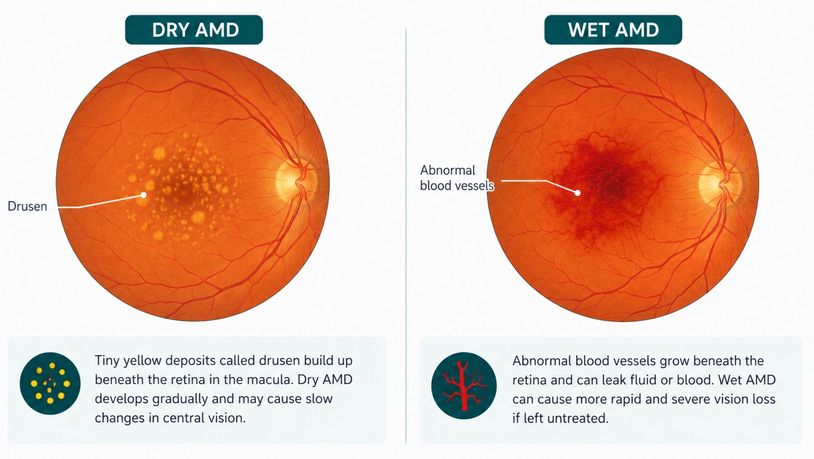
Comparison of dry and wet age-related macular degeneration showing drusen in dry AMD and abnormal bl

There are two main types of age-related macular degeneration (AMD): dry AMD and wet AMD. Although both affect the macula, they differ in how they develop and how they are managed.

Dry Macular Degeneration


Dry AMD is the most common form, accounting for approximately 80–90% of all AMD cases.
It develops gradually over time as the cells of the macula become damaged and small yellow deposits called drusen accumulate beneath the retina.


Dry AMD is characterized by:


  • Gradual changes in central vision
  • Drusen beneath the retina
  • Thinning of retinal tissue over time
  • Slow progression in most patients
  • Regular monitoring with comprehensive eye examinations and retinal imaging
  • Management that may include lifestyle recommendations, nutritional guidance when appropriate, and, for selected patients, newer options such as photobiomodulation (PBM)


Wet Macular Degeneration

Wet AMD is less common than dry AMD, but it can cause more rapid vision loss if left untreated. It develops when abnormal blood vessels grow beneath the retina. These fragile blood vessels may leak fluid or blood, damaging the macula and affecting central vision.

Wet AMD is characterized by:


  • Abnormal blood vessels growing beneath the retina
  • Leakage of fluid or blood into the macula
  • Sudden or rapidly worsening central vision
  • Straight lines appearing wavy or distorted
  • A dark or blurry spot in the center of vision
  • Often treated with medications injected into the eye (anti-VEGF therapy)
  • Prompt diagnosis and treatment offer the best chance of preserving vision

Can Dry AMD become Wet AMD?

Yes. Some patients with dry AMD may eventually develop wet AMD.


Because of this, regular comprehensive eye examinations and retinal imaging are essential. Detecting changes early allows treatment to begin as soon as possible if wet AMD develops.


Contact your eye doctor promptly if you notice:


  • A sudden decrease in vision
  • New distortion or wavy lines
  • A dark or missing area in your central vision
  • Rapid changes in one or both eyes 

How is Macular Degeneration Diagnosed?

At San Carlos Eye Care, our ophthalmologist and optometrists use advanced diagnostic technology to detect and monitor macular degeneration.  Your examination may include:


  • A comprehensive dilated eye examination
  • Optical Coherence Tomography (OCT) to evaluate the retinal layers
  • Widefield retinal imaging (fundus photography) to document changes over time
  • Visual acuity testing
  • Rabin Cone Contrast Testing to evaluate contrast and color vision
  • Additional testing when clinically indicated
     

These tools allow us to detect subtle changes, monitor disease progression, and develop a personalized management plan.

How Is Dry Macular Degeneration Managed?

There is currently no cure for dry AMD, but there are many ways to help monitor the condition and support long-term retinal health.  Depending on your individual needs, your doctor may recommend:


  • Regular comprehensive eye examinations
  • OCT and retinal imaging
  • Nutritional recommendations when appropriate
  • Smoking cessation
  • Blood pressure and cardiovascular health management
  • Monitoring your vision at home with an Amsler Grid
  • Discussion of emerging treatment options, including photobiomodulation (PBM) for selected patients
     

Macular Degeneration Care for Bay Area Patients

San Carlos Eve Care provides macular degeneration evaluation, monitoring, and ongoing care for patients throughout the San Francisco Bay Area and Peninsula. Conveniently located in San Carlos, California, we care for patients from San Mateo County and surrounding Bay Area communities with dry and wet age-related macular degeneration (AMD).


For patients with dry AMD, our doctors provide advanced retinal imaging, ongoing monitoring, personalized recommendations, and access to emerging treatment options, including photobiomodulation light therapy where appropriate.

Could Light Therapy Be Right for You?

Some patients with dry AMD may be candidates for photobiomodulation (PBM), a non-invasive light therapy designed to support retinal cell function.


PBM uses specific wavelengths of red, yellow, and near-infrared light to support cellular energy production within retinal cells.  Although it is not appropriate for everyone, your doctor can determine whether you may be a candidate after a comprehensive retinal evaluation.

Learn more about DRy AMD Light Therapy

Frequently Asked Questions

Can macular degeneration be cured?


Yes. Some patients with dry AMD may eventually develop wet AMD. This is why regular eye examinations and retinal imaging are important. Early detection allows treatment to begin promptly if wet AMD develops.


Genetics can play a role in the development of AMD. If you have a family history of macular degeneration, you may have an increased risk. Regular comprehensive eye examinations can help detect changes early.


The recommended follow-up schedule depends on the stage of your macular degeneration and your individual risk factors. Your doctor will recommend how often you should be monitored to detect any changes as early as possible.


Many people with early or intermediate AMD can continue driving safely, especially if their vision still meets legal driving requirements. However, AMD can reduce central vision, making it more difficult to read road signs, recognize pedestrians, judge distances, or drive at night. If you have AMD, regular eye examinations are important to monitor your vision. Your eye doctor can advise you whether it is safe to continue driving and discuss strategies or treatments that may help you maintain your vision.


Contact Us to Schedule a Macular Degeneration Evaluation

Request an Appointment

This site is protected by reCAPTCHA and the Google Privacy Policy and Terms of Service apply.

San Carlos Eye Care

750 El Camino Real, San Carlos, CA 94070, us

(650) 596-1999

Hours

Mon

09:00 am – 05:00 pm

Tue

09:00 am – 05:00 pm

Wed

09:00 am – 05:00 pm

Thu

09:00 am – 05:00 pm

Fri

09:00 am – 05:00 pm

Sat

By Appointment

Sun

Closed

2nd & 4th Saturdays available with Dr. Lee by appointment only 

Copyright © 2026 San Carlos Eye Care – All Rights Reserved.  

Serving the San Francisco Bay Area and Silicon Valley — proudly caring for patients from San Carlos, Redwood City, Belmont, San Mateo, Palo Alto, Menlo Park, and nearby communities.

  • Home
  • Contact Us
  • Patient Information
  • Medical History

Powered by

Cookie Policy

This website uses cookies. By continuing to use this site, you accept our use of cookies.

DeclineAccept & Close